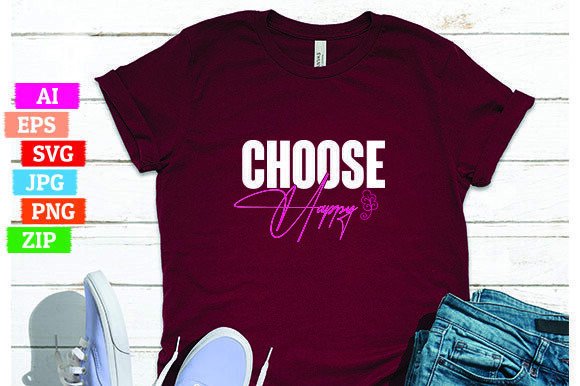
Choose Happy: A Strategic Design Asset for Modern Print-on-Demand Entrepreneurs
“Choose Happy” is more than a phrase—it’s a resonant, emotionally intelligent design concept that bridges psychological wellness with visual communication. In the crowded print-on-demand (POD) landscape, where differentiation hinges on authenticity and intentionality, this high-quality, eye-catching T-shirt design stands out not just for its aesthetics but for its layered functionality and cross-audience appeal. Unlike trend-chasing graphics that fade with seasonal shifts, Choose Happy operates at the intersection of timeless sentiment, versatile execution, and technical readiness—making it a pragmatic choice for creators, educators, small business owners, and even organizational wellness initiatives.
Why Emotional Resonance Translates to Commercial Viability
Consumer behavior research consistently shows that purchases tied to identity, values, or emotional states carry higher perceived value and stronger retention. A T-shirt emblazoned with “Choose Happy” doesn’t merely state a mood—it invites participation in a mindset. This subtle agency (“choose,” not “be”) aligns with contemporary understandings of mental resilience and self-determination theory. For educators integrating social-emotional learning (SEL), it becomes a tactile conversation starter. For therapists or workplace wellness coordinators, it serves as a nonclinical, approachable symbol of positive psychology principles. And for POD sellers, it taps into a sustained cultural current: the normalization of intentional well-being without cliché or oversimplification.
What elevates Choose Happy beyond generic positivity slogans is its visual restraint and typographic clarity. The design avoids excessive ornamentation, relying instead on balanced spacing, thoughtful weight distribution, and a carefully calibrated font hierarchy. This ensures legibility across garment types—from lightweight tri-blends to structured performance tees—and maintains impact whether printed large on the chest or scaled down for pocket placements or youth sizes.
Technical Readiness: How File Flexibility Supports Real-World Workflows
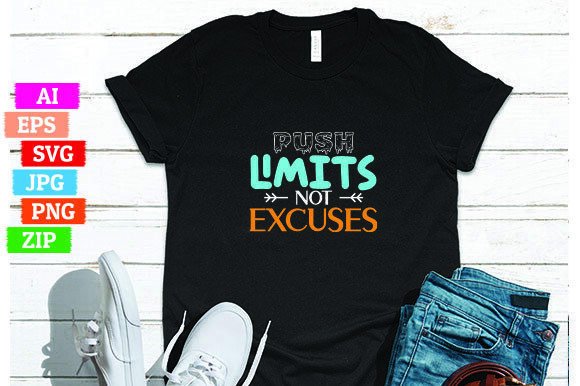
A compelling design means little without seamless integration into production pipelines. The Choose Happy package delivers five professionally prepared file formats—each serving distinct stages of the POD workflow:
- Editable AI file: Ideal for designers using Adobe Illustrator who need full vector control—adjusting anchor points, modifying stroke weights, or repositioning elements without quality loss.
- Editable SVG file: Enables direct import into web-based POD platforms like Printful, Gelato, or Gooten; supports dynamic resizing and responsive rendering for mockup generators.
- PNG file: High-resolution (300 DPI), raster-based output optimized for quick uploads to Etsy, Redbubble, or Teespring—no conversion delays or compatibility hiccups.
- Editable EPS file: Backward-compatible with legacy workflows and essential for commercial printers requiring PostScript-level precision, especially when scaling for all-over-print or oversized apparel applications.
- Transparent PNG printable: Ready for immediate use in DTG (direct-to-garment) setups—no background removal needed, preserving crisp edges and smooth gradients during ink application.
All files are compressed into a single ZIP folder—a deliberate efficiency choice. Users can extract selectively or double-click to open native applications directly, reducing friction for time-constrained creators. This isn’t just convenience; it reflects an understanding of how real-world POD operators move from concept to fulfillment: rapidly, iteratively, and often across multiple platforms simultaneously.
Adaptability Across User Contexts and Applications
The strength of Choose Happy lies in its contextual elasticity. It functions differently depending on who deploys it—and why.
For Educators and Counselors
In classroom settings, the phrase anchors discussions around growth mindset, emotional regulation, and cognitive reframing. Teachers have used the design on student-made T-shirts for school-wide wellness weeks, while counselors incorporate it into group therapy materials—not as prescriptive advice, but as an invitation to reflect on agency in emotional response. Its clean typography avoids infantilization, making it equally appropriate for middle schoolers and adult learners in continuing education programs.
For Small Business Owners and Local Brands
Independent coffee shops, yoga studios, and boutique fitness centers have adopted Choose Happy as part of branded staff apparel—not as marketing, but as internal culture reinforcement. When baristas or instructors wear it, the message becomes ambient rather than transactional. Customers absorb the ethos without being sold to. That subtlety builds trust more effectively than overt slogans about “quality” or “community.”
For Researchers and Wellness Practitioners
Behavioral scientists studying visual priming have referenced designs like Choose Happy in pilot interventions exploring how environmental cues influence affective states. Its grammatical structure (“choose” as active verb) makes it particularly useful in experimental protocols where linguistic framing matters. Similarly, occupational therapists working with neurodiverse clients report success using the design in sensory-friendly clothing selections—its predictable rhythm and absence of visual clutter reduce cognitive load.
For Hobbyists and Creative Entrepreneurs
Hobbyists appreciate the editable nature of the files—not to overhaul the design, but to personalize it thoughtfully. One user added a minimalist sun icon beside “Happy” for a summer collection; another adjusted letter spacing to fit a curved hemline on a cropped tee. These micro-adaptations preserve the core integrity while allowing brand-specific expression—something rigid, non-editable assets cannot support.
Design Integrity Meets Production Practicality
Many POD designs sacrifice print fidelity for visual flair—thin strokes vanish on fabric, gradients band under heat press, or intricate outlines misalign during screen printing. Choose Happy avoids these pitfalls through deliberate construction:
- Stroke widths exceed minimum thresholds recommended by major DTG providers (≥0.75 pt at final size).
- No overlapping semi-transparent layers that cause unintended color blending during RIP processing.
- Color palette uses Pantone-referenced CMYK-safe values, minimizing gamut shift between digital proof and physical output.
- Transparency is limited to the background layer only—no alpha channels embedded in text or shapes that could confuse RIP software.
This attention to prepress detail reduces failed test prints, lowers customer returns due to color mismatch, and increases first-time-right success rates—key metrics for POD sellers operating on thin margins and tight turnaround expectations.
Strategic Positioning in a Saturated Market
Search data reveals steady, year-round interest in phrases like “positive mindset shirt,” “mental health apparel,” and “wellness-themed T-shirts”—but competition spikes around January (New Year resolutions) and May (Mental Health Awareness Month). What sets Choose Happy apart is its avoidance of reactive timing. It doesn’t rely on calendar-driven relevance; instead, it leverages evergreen psychological insight. That stability allows sellers to build long-term listings with consistent traffic, rather than chasing algorithmic volatility.
Moreover, the design sidesteps common SEO pitfalls: it contains no keyword stuffing, no misleading claims (“cure anxiety”), and no culturally appropriative motifs. Its language is inclusive—neither prescriptive nor exclusionary—and its visual tone remains warm without veering into saccharine. That balance supports E-E-A-T (Experience, Expertise, Authoritativeness, Trustworthiness) signals valued by search engines and human audiences alike.
Implementation Considerations Beyond the Download
While the file package provides immediate utility, thoughtful implementation requires additional reflection:
First, consider garment pairing. The design performs exceptionally well on heathered grays, oatmeals, and deep navy—colors associated with calm and sophistication. Avoid pairing it with overly busy patterns or neon bases that visually compete with its quiet confidence.
Second, think about audience segmentation. A version with slightly bolder tracking may resonate more with athletic wear buyers, while tighter kerning suits minimalist streetwear audiences. These aren’t edits to the core design—but informed deployment choices enabled by having editable source files.
Third, recognize licensing boundaries. The Choose Happy files are licensed for commercial POD use, but not for resale as standalone digital assets. That distinction protects both the creator’s IP and the buyer’s ability to operate compliantly across platforms—many of which flag unauthorized digital resales.
Finally, pair the design with authentic storytelling. On product pages, avoid generic copy like “Great shirt!” Instead, describe how the phrase functions in daily life: “Worn by teachers before parent-teacher conferences. Chosen by therapists for client-facing sessions. Selected by students building personal mantras.” Such context transforms a graphic into a shared reference point—deepening connection far beyond the transaction.
In essence, Choose Happy represents a convergence: of emotional intelligence and design craft, of technical precision and human-centered messaging, of commercial practicality and philosophical depth. It doesn’t shout. It doesn’t overpromise. It simply offers a clear, usable, and ethically grounded tool—one that earns its place in wardrobes, classrooms, clinics, and creative studios—not because it follows trends, but because it supports meaningful action.