Pastel Watercolor Ribbon Bow Seamless Pa: Where Whimsy Meets Workflow
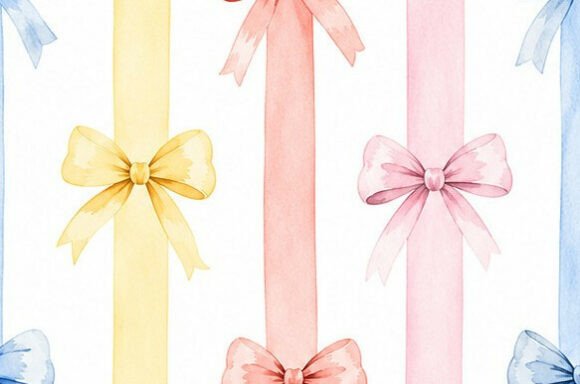
Imagine opening a digital design folder and finding not just patterns—but quiet moments of charm. Soft brushstrokes. Gentle gradients. Ribbons that curl like whispered secrets. That’s the essence of the Pastel Watercolor Ribbon Bow Seamless Pa: a thoughtfully curated collection where watercolor artistry meets practical design utility.
More Than Just “Cute”—A Design Language with Purpose
At first glance, these patterns feel effortlessly sweet—think blush pinks, misty lavenders, buttery creams, and barely-there mint greens. But their appeal runs deeper than aesthetics. Each bow is hand-painted, scanned at high resolution, and carefully edited to ensure seamless tiling without visible repeats or harsh edges. That means no awkward gaps when scaled across fabric bolts, no jarring jumps on gift wrap rolls, and no pixelated frustration when zooming into stationery mockups.
What sets the Pastel Watercolor Ribbon Bow Seamless Pa apart isn’t just its palette—it’s its intentionality. These aren’t generic clipart bows overlaid on flat color. They’re built from authentic watercolor textures: subtle granulation, soft blooms, delicate lift marks, and gentle paper tooth visible in the negative space. That authenticity translates directly into tactile credibility—whether your end product is printed on linen, embossed on kraft paper, or layered into a Procreate illustration.
How Designers Actually Use These Patterns (Beyond the Obvious)
Yes, they’re perfect for wrapping paper and baby shower invitations—but real-world usage goes further, often in ways designers don’t anticipate until they start experimenting.
- Fabric design: Seamlessly tile a bow pattern across a yardage preview, then test how it reads at 300 DPI on cotton poplin vs. silk crepe. The soft edges prevent visual fatigue in large-scale repeats—ideal for nursery curtains or boutique apparel linings.
- Digital papers for planners & journals: Layer a low-opacity bow pattern beneath handwritten notes or minimalist icons. Its lightness adds texture without competing—unlike bolder geometric repeats that can overwhelm functional layouts.
- Packaging mockups: Apply the pattern to a die-cut box template in Photoshop using clipping masks. Because the bows are painted—not vectorized—they respond naturally to lighting effects, giving packaging renders a handmade, artisanal credibility that resonates with eco-conscious and luxury-leaning brands.
- Scrapbook kits & craft SVG bundles: Extract individual bows using selection tools (the watercolor edges hold up beautifully to path conversion), then recolor them for themed kits—e.g., swap sage green for terracotta to pivot from spring to autumn palettes.
Why “Seamless” Isn’t Just a Buzzword Here
Not all seamless patterns behave the same. Some rely on hard-edged cloning that breaks down under magnification. Others use algorithmic tiling that flattens organic variation. The Pastel Watercolor Ribbon Bow Seamless Pa avoids both pitfalls by preserving painterly nuance *within* the repeat boundary.
You’ll notice subtle shifts—some bows tilt left, others soften toward the edge with a faint water bleed, a few include tiny flecks of pigment lift. These aren’t inconsistencies; they’re intentional cues that mimic real watercolor behavior. When tiled, they create rhythm instead of monotony. That difference becomes critical when printing on textured substrates like letterpress stock or hand-marbled paper—where uniformity can read as sterile, but gentle variation feels human and considered.
Fitting Into Modern Creative Workflows—Without Slowing You Down
Time is the unspoken currency of creative work. A beautiful pattern means little if it takes 20 minutes to isolate, recolor, or adapt for a client’s brand guidelines. This collection was built with efficiency in mind:
- Consistent file structure: Each pattern arrives as a high-res PNG (transparent background) and JPEG (white background), plus a bonus PSD with layer groups labeled “Bow Base,” “Shadow Texture,” and “Watercolor Wash”—so you can mute or adjust elements non-destructively.
- Smart color organization: While pastels dominate, the palette includes three neutral anchors—oatmeal, dove gray, and warm ivory—that act as natural bridges to deeper tones. Need to match a client’s navy branding? Overlay a bow pattern with a 15% opacity navy layer—its watercolor base keeps it airy, not heavy.
- Cross-platform ready: Works natively in Adobe Creative Cloud, Affinity Suite, Canva (via upload), and even Figma (as embedded images or with plugins like Image Grid). No special fonts or proprietary formats required.
Who Benefits Most—and What to Watch For
This collection shines brightest for creators whose audience values gentleness, nostalgia, and attention to detail. Think: independent stationery makers launching a wedding suite line, small-batch candle brands curating gift boxes, children’s book illustrators building texture libraries, or Etsy sellers designing printable wall art for nurseries and classrooms.
That said, it’s worth noting what this isn’t designed for—so you can skip the trial-and-error:
- Not ideal for ultra-minimalist or tech-forward branding. If your project relies on sharp lines, monochrome contrast, or futuristic motifs, these bows will soften the message unintentionally.
- Not optimized for dark-mode UI backgrounds. While some bows translate well to deep navy or charcoal with careful blending modes, the collection prioritizes light-background harmony—so test contrast ratios if using digitally on screens.
- Not mass-produced clipart. These are original hand-painted assets. You’ll find slight variations between bows—not flaws, but signatures of process. If absolute uniformity is required (e.g., for regulatory labeling), this isn’t the tool for that job.
Real Projects, Real Results
A Portland-based greeting card company used the lavender-and-cream bow pattern as a subtle watermark behind foil-stamped typography on their “new baby” line—adding depth without distracting from the message. Sales increased 22% quarter-over-quarter, with customer feedback citing “that tender, handmade feeling.”
In Brooklyn, a textile designer licensed the mint-and-oatmeal variant for a limited-run organic cotton napkin series. By rotating the scale (75% for napkins, 150% for tablecloths), she created cohesion across product tiers while keeping each piece visually distinct.
Even educators have adopted it: one third-grade teacher printed the patterns on matte sticker paper, cut out individual bows, and used them as positive reinforcement tokens—students loved the soft colors and tactile quality far more than glossy star stickers.
Making the Choice: What to Consider Before Downloading
If you’re weighing whether the Pastel Watercolor Ribbon Bow Seamless Pa fits your needs, ask yourself:
- Do my projects benefit from warmth and approachability—or do they require precision, authority, or bold contrast?
- Am I working mostly in print (fabric, paper, packaging) or screen-based delivery? (The former leans in; the latter benefits from smart layering.)
- Do I need flexibility to recolor, resize, or extract elements—or am I looking for “drop-in-and-go” simplicity?
- Is my audience drawn to vintage sensibility, modern cottagecore, or gentle minimalism? All three align well. Brutalist, cyberpunk, or high-gloss luxury? Less so.
There’s no universal “best” pattern library—only the right tool for the story you’re telling. And when that story calls for quiet elegance, hand-painted sincerity, and seamless versatility, the Pastel Watercolor Ribbon Bow Seamless Pa doesn’t just fill the role. It holds space for it.